
15 years before gas module inspection: what the passport leaves out
Some manufacturers' gaseous suppression module passports specify 15 years before first inspection without supporting this through seal life. Under ГОСТ 18829-2017, no O-ring rubber group has a 15-year service life: typical rubbers last 5.4–7 years and special grades up to 11. International practice inspects and tests these cylinders every 5–10 years. Module warranties last 18–36 months, leaving the customer responsible for events between warranty expiry and first inspection.
What does the passport say?
This article is for customers, designers and operating organisations. We examine the passport, the standard, the gap between them and how to address it before signing a contract.
Some manufacturers' passports specify 15 years before the first inspection. They do not explain the basis: there is no reference to rubber grade, ageing tests or a seal replacement schedule.
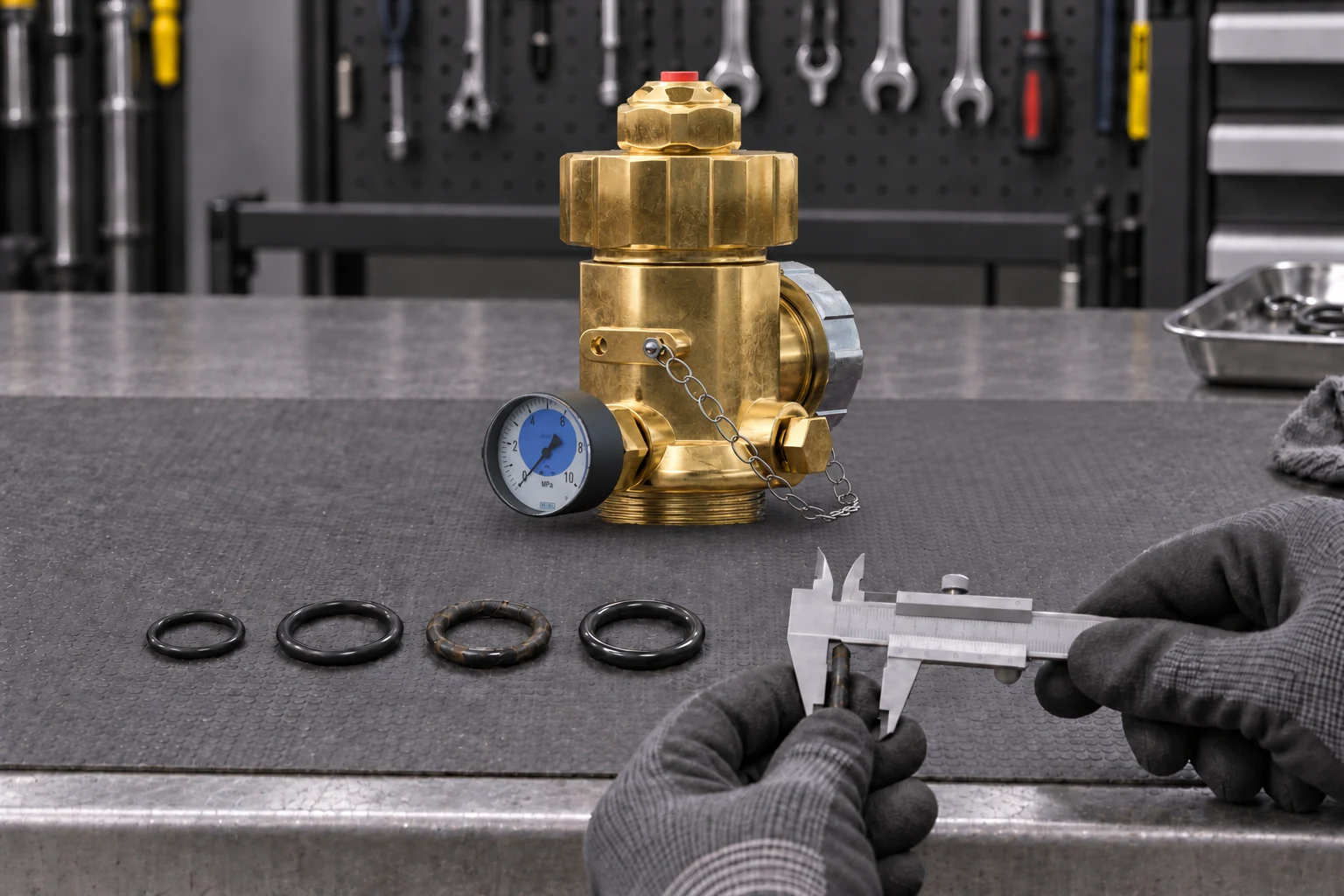
Inspection examines the cylinder as a pressure vessel: steel, welds and strength. A module includes more than a cylinder. Rubber seals are located in at least three places: the cylinder neck, gauge connection and piston mechanism inside the discharge valve (ЗПУ). They retain agent and nitrogen under pressure for years.
A steel cylinder may last 15 years; the rubber seals in the neck, gauge and valve do not. When one figure covers the whole module, the customer reads it as no intervention needed for 15 years. This is where the misunderstanding begins.
Why does a 15-year interval differ from international practice?
International practice does not leave gaseous suppression cylinders unchecked for more than 5–10 years. None of these documents allows a 15-year gap: US cylinders are inspected every 5 years and European cylinders tested every 10.
| Region | Document | Requirement | Interval |
|---|---|---|---|
| USA | NFPA 2001 | Full external inspection of cylinders in service without discharge | every 5 years |
| USA, Canada | NFPA 2001, DOT and CTC requirements | Retesting before recharge if more than 5 years have passed since the last test | 5 years |
| EU, United Kingdom | TPED and ADR, Euralarm guidance (distributed by FIA) | Periodic cylinder testing | every 10 years |
Large service providers organise maintenance around the 10-year point. Johnson Controls, for example, offers hydrostatic testing of FM-200, CO₂ and inert gas cylinders after 10 years. Agent is removed and valves refurbished or replaced, bringing seals to a specialist before their life expires. Euralarm explicitly notes that halocarbon cylinder valves use a rubber O-ring on a parallel thread and that manufacturers may specify shorter inspection intervals for valves and other assemblies.
A 15-year interval breaks this logic. The first disassembly occurs after all rubber groups in ГОСТ 18829-2017 have exhausted their specified life. No advanced technology supports the figure: an attractive passport number replaces a justified interval, a problem in the market.
What does ГОСТ 18829-2017 say?
ГОСТ 18829-2017, Rubber O-rings for hydraulic and pneumatic devices, is an interstate standard whose adoption Kazakhstan supported. It specifies total service life by rubber group. The maximum is 11 years, and only for special heat-resistant rubbers.
| Rubber group | Static pneumatic connections (table 6), years | Hydraulic devices (table 4), years | Does it reach 15 years? |
|---|---|---|---|
| 0, 1, 2, 3 | 5,4 | 6 | No |
| 4 | 6,3 | 7 | No |
| 5, 6, 7 | not specified | 11 | No |
| 8 | not specified | 10 | No |
Intervals apply at up to 25 °C to accuracy group 2 rings; group 1 allows 10% more. Even the best case is 12.1 years, not 15. At higher room temperatures, the standard expresses life in hours.
Four more ГОСТ provisions customers should know:
- Life starts when the ring is installed in the product (table 4, note 2), meaning factory module assembly rather than site commissioning. Storage and installation time already consume its life.
- Ring manufacturers warrant static pneumatic seals for 2 years from commissioning (10.2), which the standard defines as installation of the ring in the assembly. Even the rubber manufacturer promises no longer period.
- Ring integrity is checked at each maintenance visit; defective rings are removed (9.3), and removed rings must not be reused (9.4).
- If operating conditions differ from those covered by the standard, the manufacturer and customer set the product-specific service life (3.1.16). The module manufacturer should therefore have a document supporting 15 years. It is absent from the passport.
Three-year warranty, inspection after 15: who is responsible in between?
These modules have an 18–36 month warranty and a 15-year first inspection interval. The gap is 12–13.5 years for which the manufacturer accepts no warranty responsibility.
Example: a module assembled in 2026 has a 36-month warranty ending in 2029. In year 11, in 2037, the valve seal leaks or fails during a fire. The manufacturer rejects the claim because the warranty expired eight years earlier. Passport inspection is not yet due, so the factory's schedule has not been breached either. The owner bears the consequences.
The arithmetic is simple: 15 years helps sell the product, while the buyer bears the risk.
What happens to rubber after 10 years?
Rubber ages even if the module never activates. For years the ring remains compressed, under pressure and in contact with HFC agent and nitrogen, conditions that accelerate ageing. Most properties listed below are controlled by ГОСТ 18829-2017 (table 2, appendix Д) and deteriorate over time.
- Compression set. The ring retains its compressed shape and stops recovering. Its round cross-section flattens, contact pressure against metal falls, and a microleak lets gas escape over years.
- Hardening and loss of elasticity. Rubber oxidises and hardens. A hard ring cannot follow thermal metal expansion and pressure changes; it acts as a rigid gasket rather than an elastic seal.
- Cracks. Heat, oxygen and ozone create surface microcracks, especially on externally exposed rings. A crack crossing the section is no longer a microleak but a gas channel.
- Shrinkage or swelling in the extinguishing agent. Years of contact with HFC agent leach plasticiser from rubber. The ring shrinks and loses interference, or swells and weakens. ГОСТ specifies mass changes in working media for a reason.
- Loss of cold resistance. Aged rubber becomes glassy at a higher temperature. In unheated or poorly heated rooms in Kazakhstan, an old ring can lose sealing in winter or crack during a pressure surge.
- Adhesion to metal. Years of static contact cause rubber to adhere to the surface and lose lubrication, increasing breakaway force. This is the most dangerous mechanism for moving parts such as the discharge valve piston.
- Extrusion and tearing during actuation. Pressure and flow velocity change sharply during activation. Weakened, brittle rubber may extrude into a gap or tear precisely when it is needed most.
All seven processes occur together and reinforce one another. After 10 years, the question is which mechanism fails first, rather than whether the ring has aged.
Three assemblies with seals: where can a module fail?
Seals are in the cylinder neck, gauge connection and valve piston mechanism. These are three independent failure points; failure of any one can prevent suppression. All age together from module assembly.
| Component | How the seal works | Effect of failure | Can maintenance detect it? |
|---|---|---|---|
| Cylinder neck (valve connection) | Static seal continuously retaining full charge pressure | Slow agent and nitrogen leakage; rupture of the aged seal during actuation, losing some gas outside the pipework | Partly: through the gauge and weighing if maintenance follows the schedule |
| Pressure gauge connection | Small-diameter static seal under the same pressure | Leakage through a secondary assembly empties the module just as leakage through the neck does | Partly: pressure loss is visible, but its cause cannot be found without disassembly |
| Piston inside the discharge valve | Dynamic seal: remains still for years, operates once at actuation | The piston sticks or moves late; actuation pressure escapes past the ring and the valve does not fully open | No: the gauge reads normal; piston condition is apparent only during disassembly or actuation |
The first two assemblies may reveal themselves through pressure loss; the valve piston does not. It is not visually monitored or checked during routine maintenance, and moves for the first time in years during a fire. This is where a seal in its eleventh year poses the greatest risk.
How dangerous is it?
The greatest danger of an old seal is hidden failure. The module is installed, the gauge is in the green zone and maintenance records are complete, yet failure may become apparent only during a fire.
What happens during a fire if a seal fails:
- Gas does not discharge or is delayed. The fire grows even though automation has formally activated.
- The gas charge is below the calculated amount. The specified concentration is not reached or maintained long enough; flames die down then reappear.
- One failed module undermines the entire system calculation. Agent mass is calculated for the whole room; one missing cylinder can lower concentration below the extinguishing level.
Gaseous systems protect valuable assets: server rooms, archives, switchgear rooms, control rooms and museum stores. Water is unacceptable and fire interrupts business. A failed module means lost equipment and data, downtime and, in the worst case, danger to people.
After a fire, insurers and regulators will ask when seals were replaced. Never, the passport says 15 years is no protection: the ГОСТ seal life and manufacturer's warranty have expired. The owner is responsible for keeping fire protection systems operational.
What should the customer do?
Ask the supplier three questions before purchase and request written answers:
- Which rubber group and grade are used for the neck, gauge and valve piston seals, and what is their service life?
- What supports 15 years: ageing test reports, an agreement under clause 3.1.16 of ГОСТ 18829-2017 or another document?
- When and by whom will seals be replaced before inspection, and at what cost?
Without a clear answer, treat 15 years as applying to the cylinder body only.
Include the following in the contract and specification:
- a separate seal service life entry referencing ГОСТ 18829-2017 or a test report;
- the module assembly date in the passport, since seal life starts from that date;
- the supplier's obligation to provide seal kits and replacement instructions throughout operating life.
Add the following to the maintenance schedule:
- charge pressure and mass checks under the schedule, recorded in the log;
- seal integrity checks at each maintenance visit (ГОСТ 18829-2017, clause 9.3);
- scheduled seal replacement and valve overhaul no later than the service life for the rubber group, measured from module assembly.
Conclusion
Fifteen years before first inspection concerns the steel cylinder, not the whole module, and differs from international 5–10 year practice. Neck, gauge and valve piston seals last 5.4–11 years under ГОСТ 18829-2017, while module warranty ends after 1.5–3 years. Until the passport explains the basis for 15 years, plan seal replacement by ГОСТ rather than the advertised figure, and obtain the interval in writing before signing.
We inspect and refill FireStop modules ourselves; see the page on “Cylinder inspection and refilling”.
Frequently asked questions
How long do gaseous suppression module seals last?
ГОСТ 18829-2017 specifies total seal life of 5.4–11 years by rubber group at up to 25 °C. Static pneumatic seals last 5.4 years for groups 0–3 and 6.3 years for group 4. Life starts when the seal is installed in the product, meaning module assembly.
Can a removed seal be reused?
No. ГОСТ 18829-2017 prohibits reinstalling removed rings (9.4). At each maintenance visit, integrity is checked and defective seals replaced (9.3). Valve overhaul therefore requires a seal kit, whose supply should be secured in the contract.
Does cylinder inspection cover seals?
Inspection examines the cylinder as a pressure vessel: metal, welds and strength. Neck, gauge and valve piston seals are not part of vessel strength. They are checked during maintenance and valve overhaul, with replacement governed by rubber life under ГОСТ 18829-2017.
Sources
- ГОСТ 18829-2017, Rubber O-rings for hydraulic and pneumatic devices. Specifications: clauses 3.1.10, 3.1.13, 3.1.15, 3.1.16, 9.3, 9.4, 10.2; tables 2, 4, 6; appendix Д.
- Koorsen Fire & Security: NFPA 2001 requirements for clean agent system inspection and testing (in English).
- FSSA: Gaseous Agent Cylinder Retest Intervals, NFPA 2001 clauses 7.2.1 and 7.2.2 (in English, PDF).
- Johnson Controls UK: gaseous suppression cylinder maintenance and replacement (in English).
- Johnson Controls UK: gaseous suppression cylinder hydrostatic testing (in English, PDF).
- Euralarm: Periodic testing of transportable gas containers used in fire extinguishing systems, V2.0, 2023 (in English, PDF).