
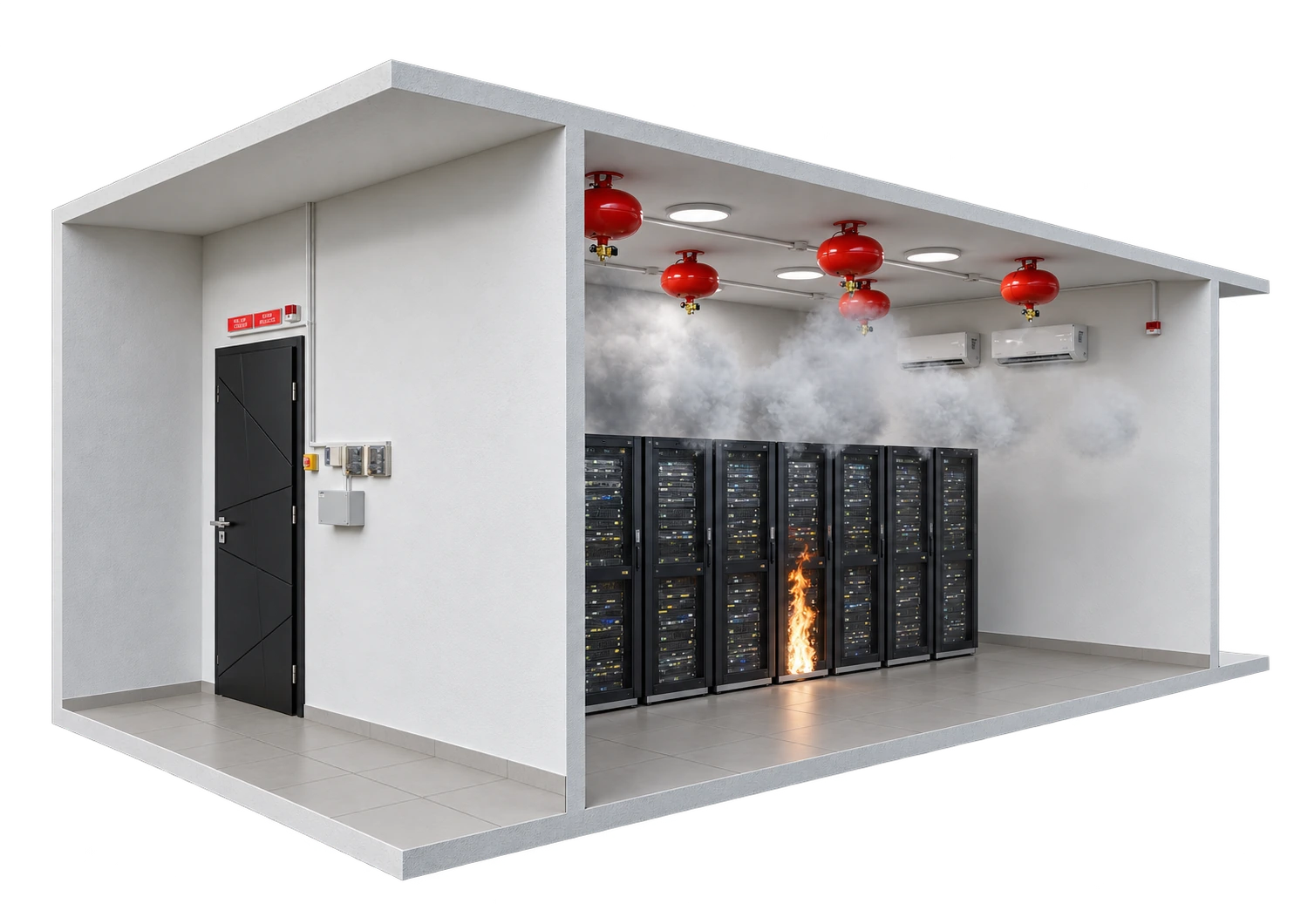
Server room fire safety considerations
A server room concentrates expensive equipment and company data in a few square metres, with round-the-clock electrical load. Bundled cables run beneath raised floors and above suspended ceilings, racks generate heat and air conditioners circulate air. With people usually absent, a fire may be noticed late.
Potential ignition sources:
- short circuits in wiring, power supplies or servers;
- rack overheating after air conditioning failure;
- UPS, battery and switchboard faults;
- electrical installation and maintenance errors;
- hidden defects in cables and switching equipment.
Consequences of a fire for the company:
- data loss and IT system interruption;
- server, storage and network equipment replacement costs;
- downtime until services are restored;
- information security risks;
- questions from customers and partners about why everything stopped.
Office server room and data centre: two different tasks
An office server room is usually 3–15 m². There is no space for a module bank, and welding pipework in an operational room is unacceptable. Suspended modules protect such rooms: ceiling mounting, no pipe network and quick installation.
A data centre has hundreds of racks, powerful cooling, and hot and cold aisles. Airflow spreads smoke around the hall, so conventional point detectors may respond late. Data centres use a centralised station with pipework and early smoke detection.
False discharge also costs money
Accidental discharge interrupts operations and requires module refilling. Worse can happen: during a 2016 suppression system test at ING's Bucharest data centre, loud gas discharge from nozzles damaged hard drives, leaving customers unable to use cards or online banking for hours. Server room designs therefore address more than agent mass: two-detector confirmation, a pre-discharge delay and nozzle noise.
Regulatory requirements for server room fire protection in Kazakhstan
Many Kazakhstan texts on server room suppression are copied from Russian sites along with Russian standards: SP 5.13130.2009, GOST R 53281-2009 and Federal Law No. 123. Experts and emergency department inspectors assess Kazakhstan facilities against Kazakhstan documents.
| Document | What to check for a server room |
|---|---|
| Technical regulation “General Fire Safety Requirements” (Kazakhstan Ministry of Emergency Situations Order No. 405 of 17 August 2021) | Four provisions matter for a server room. Appendix 16 and clauses 44–50 set the room category. Clause 150 prohibits running gas suppression and smoke ventilation at the same time, and clause 135 requires gas removal after extinguishing as designed. Clauses 210 and 212 cover equipment: it must comply with TR EAEU 043/2017, and cylinders are inspected before installation. |
| СН РК 2.02-02-2023 “Fire Automation of Buildings and Structures” | Section 5 answers whether a server room must have an automatic system. Section 9 is entirely about gas: system design (9.1), nozzles (9.2), protected room requirements (9.3), local application by volume (9.4) and control (9.5). |
| СП РК 2.02-102-2022 “Fire Automation of Buildings and Structures” | Section 5.4 and Appendices Г–Е: how to calculate the agent mass, correction factors and the pressure relief opening for a server room. FK-5-1-12 is not included in the code's table of agents. |
| Fire Safety Rules (Kazakhstan Ministry of Emergency Situations Order No. 55 of 21 February 2022) | Needed for handover and operation of a server room: clause 70 describes the acceptance certificate, and clause 76 prohibits installing cylinders whose inspection period has expired. |
| Unified ICT and information security requirements (Kazakhstan Government Resolution No. 832 of 20 December 2016) | For government server rooms. Clause 159: fire alarm independent of the building. Clause 160: automatic gaseous suppression only, no powder or liquids, discharge delay no more than 30 seconds, ventilation and equipment power shutdown, and gas extraction by exhaust ventilation. |
| TR EAEU 043/2017 | Modules and agent for a server room must hold a certificate of conformity with this regulation. |
| ST RK 1902-2009 | Gaseous suppression system modules and banks: general technical requirements and test methods. Kazakhstan counterpart of GOST R 53281-2009. |
| ST RK 1900-2009 | Selector valves for gaseous fire suppression systems. |
| ST RK 2512-2014 | Extinguishing gases: acceptance rules and test methods. |
ST RK 1900-2009, 1902-2009 and 2512-2014 are listed under EAEU TR 043/2017. The old SN RK 2.02-11-2002 was repealed on 1 March 2023 but is still cited in briefs. Ask for such references to be updated before expert review.
At what area does server room protection become mandatory?
Russian articles cite a 24 m² threshold from Russian SP 5.13130.2009 (Appendix A, Table A.3). Kazakhstan's rooms requiring suppression are listed in Section 5 of SN RK 2.02-02-2023. The current edition includes amendments as of 11 August 2026; check your room's threshold there.
The standard sets a minimum. Owners voluntarily protect smaller rooms with gas when downtime and data loss cost more than the system.
Server room fire hazard category
Server rooms fall within fire hazard categories V1–V4. The designer calculates the specific category from the room area's specific fire load under Appendix 16 of Technical Regulation No. 405 and records it in the design (Clause 45).
| Category | Specific fire load in the area, MJ/m² |
|---|---|
| В1 | over 2200 |
| В2 | 1401 to 2200 |
| В3 | 181 to 1400 |
| В4 | 1 to 180 |
System acceptance from 2026
Since 1 February 2026 the finished system is accepted by the emergency situations department of the region or city of republican significance. The application is submitted electronically with a digital signature, together with the approved design, a positive expert review and equipment conformity documents. The term is up to 15 working days and there is no fee. Acceptance is refused if the system was not installed to the design or the documents are unreliable.
Benefits of gas suppression for server rooms
- Equipment is not damaged. Water and foam soak circuit boards; powder and aerosol deposit dust. Gas leaves no residue, allowing components untouched by fire to keep working.
- Fires are extinguished in seconds. The system discharges after fire confirmation, while one unit rather than the whole rack is burning.
- Gas fills the entire volume. It reaches inside racks, beneath raised floors and above suspended ceilings carrying cables.
- Gas is non-conductive. It suppresses fires in energised equipment.
- Downtime is short. Servers can restart after room ventilation.
| Suppression method | Residue on equipment | Volume and concealed spaces | Server room after discharge |
|---|---|---|---|
| Water, foam | water, foam | do not enter racks | equipment replacement required |
| Powder | fine dust causing corrosion | poor penetration | lengthy cleaning, some equipment replacement |
| Aerosol | residue on circuit boards | poor penetration | equipment cleaning |
| Gas | none | fills the entire volume | ventilation and restart |
Which agents suit a server room?
Server rooms commonly use HFC-227ea, HFC-125 and FK-5-1-12 fluoroketone. Inert gases (nitrogen, argon, Inergen) need several times more cylinders and space. Carbon dioxide is not used in occupied server rooms because its extinguishing concentration is life-threatening.
HFC-227ea and HFC-125
- effectively suppress electrical equipment fires;
- require lower concentrations and fewer cylinders than inert gases;
- compact modules are easier to fit in small technical rooms;
- extinguish early-stage fires in seconds.
HFC-125 costs less, but its 9.8% operating concentration exceeds the 7.5% human safety threshold. It is not used where staff are present.
Fluoroketone FK-5-1-12
- does not deplete the ozone layer;
- non-conductive and does not corrode electronics;
- evaporates without residue even if it lands on equipment;
- it has the widest safety margin of the three agents: a 10% threshold at an extinguishing concentration of 5.4%.
Agent comparison for a 100 m³ server room in Almaty
| Gas | Design concentration | Human exposure safety threshold (NOAEL, NFPA 2001) | Gas weight | Module |
|---|---|---|---|---|
| HFC-227ea | 7,2 % | 9,0 % | 63.8 kg | 1 × 60 l |
| Fluoroketone FK-5-1-12 | 5,4 % | 10 % | 87.7 kg | 1 × 80 L |
| HFC-125 | 9,8 % | 7.5%, below the working concentration | 63.9 kg | 1 × 80 L |
The calculation is preliminary. Almaty lies at about 850 m above sea level, so the agent mass is multiplied by a 0.90 correction factor from Table Д.11 of SP RK 2.02-102-2022. The designer calculates the exact mass from the tightness and openings of your server room.
FK-5-1-12 is not included in SP RK 2.02-102-2022. Under clause 9.1.6 of SN RK 2.02-02-2023, systems using it are designed to the documentation of the agent or system manufacturer. The table uses 5.4% from Russian SP 485 as amended by Amendment No. 2. If your design shows a different figure, ask the designer which document it is based on.
How to choose: use FK-5-1-12 fluoroketone where people work in the room. If access is infrequent and price matters, HFC-227ea is suitable. Room volume, module space and the customer's environmental requirements also influence selection.
Gaseous fire suppression system design
The design has two parts. The mechanical section describes agent modules, pipework and nozzles. The electrical section describes detectors, warning devices, the control panel and illuminated signs at the entrance.
For a server room, the designer specifies:
- agent mass including raised-floor and ceiling-void volumes if not separated from the room;
- altitude correction: mountain sites such as Medeu and Shymbulak require less agent; omitting the correction results in excess modules;
- nozzle placement providing full coverage without discharge noise damaging drives;
- early smoke detection: aspirating detectors draw air samples through pipes, including from inside racks;
- two-detector actuation and a delay allowing cancellation after a false alarm;
- warnings for staff who may be in the room;
- ventilation and air conditioning shutdown before discharge (Clause 150 of Technical Regulation No. 405);
- automatic, remote and manual actuation;
- a calculated pressure relief vent;
- post-suppression gas removal procedures (Clause 135 of the same regulation).
Raised floor, ceiling and aisles
Experienced server room designers advise that voids below 250 mm generally need no separate nozzles if floor or ceiling perforation is at least 30%. Hot and cold aisles also usually have no separate nozzles: their volume is far smaller than the hall, making hydraulic balancing difficult.
Suspended or floor-mounted modules
Suspended modules suit small server rooms: quick installation without pipes or shutdown. Larger rooms or data centres need floor-mounted modules with pipework. The bank can be placed next door to preserve rack space.
We manufacture FireStop modules in Almaty and design for the actual equipment, avoiding rework during installation. If you already have a design, even for another manufacturer, we review agent calculations, nozzles, pipework and pressure relief free of charge.
Design stages
1. Pre-design server room survey
- measure the room and inspect racks, raised floor, ceiling and openings;
- review ventilation, air conditioning and power;
- check airtightness and identify critical areas.
2. Design
- prepare a technical brief considering your IT infrastructure;
- calculate agent mass, hydraulics, discharge time and pressure relief;
- select modules, detectors and controls and prepare an AGSK-coded specification;
- agree the agent and equipment layout with your IT specialists.
3. Expert review and approvals
- submit the design for expert review and resolve comments until a positive conclusion is issued;
- agree an installation schedule that keeps servers running.
4. Installation, commissioning and handover
- install only cylinders with valid inspection status (Clause 76 of Fire Safety Rules and Clause 212 of Technical Regulation No. 405);
- install beside operating servers with minimal infrastructure disruption;
- test each component, then the whole system without discharge;
- train your IT staff and hand the system over to the emergency situations department.
5. Maintenance
- inspect the system to schedule and record the work in the log;
- check the detectors and the control panel;
- monitor the pressure and agent mass in the modules;
- service the cylinders and valves without stopping the servers.
How much does server room gas suppression cost?
Pricing is calculated for the facility and depends on:
- room volume including raised-floor and ceiling voids;
- the chosen agent: fluoroketone, HFC-227ea or HFC-125;
- suspended modules or floor-mounted modules with pipework;
- number and size of pressure relief vents;
- control equipment: detectors, control panel and warnings;
- design, expert review and subsequent maintenance.
Frequently asked questions
Can anyone remain in the server room during discharge?
No. Even below the safety threshold, people leave on the warning signal during the pre-discharge delay. Re-entry occurs after ventilation.
Must server power be disconnected before discharge?
Gas is non-conductive and can suppress energised equipment. The system shuts down ventilation and air conditioning before discharge. Government server rooms must also shut down equipment power under the Unified ICT Requirements (Clause 160 of Resolution No. 832). Other facilities follow the design.
Can a design based on Russian standards be used?
For expert review and acceptance in Kazakhstan the calculation follows SN RK 2.02-02-2023 and SP RK 2.02-102-2022, so a Russian design has to be checked against these documents. Ask separately about fluoroketone: it is not in the Kazakhstan code, and the designer justifies its concentration with the manufacturer's documentation (SN RK clause 9.1.6).
Who may install and maintain the system?
An organisation with a Kazakhstan Emergencies Ministry permit for fire automation installation and servicing. Trained facility staff may perform monthly inspections.
Can powder fire suppression be used in a server room?
Powder modules will put out a fire, but for a server room they are a poor choice. Powder spreads throughout the room, gets inside servers, power supplies and connectors and settles there as dust. After extinguishing, the equipment has to be dismantled and cleaned, and even hardware the fire never reached is taken out of service for cleaning.
Gas leaves no residue: after ventilation, the surviving servers keep working. For a small server room the gas system is built on ceiling-mounted modules without pipes, so it is no harder to install than a powder system.