
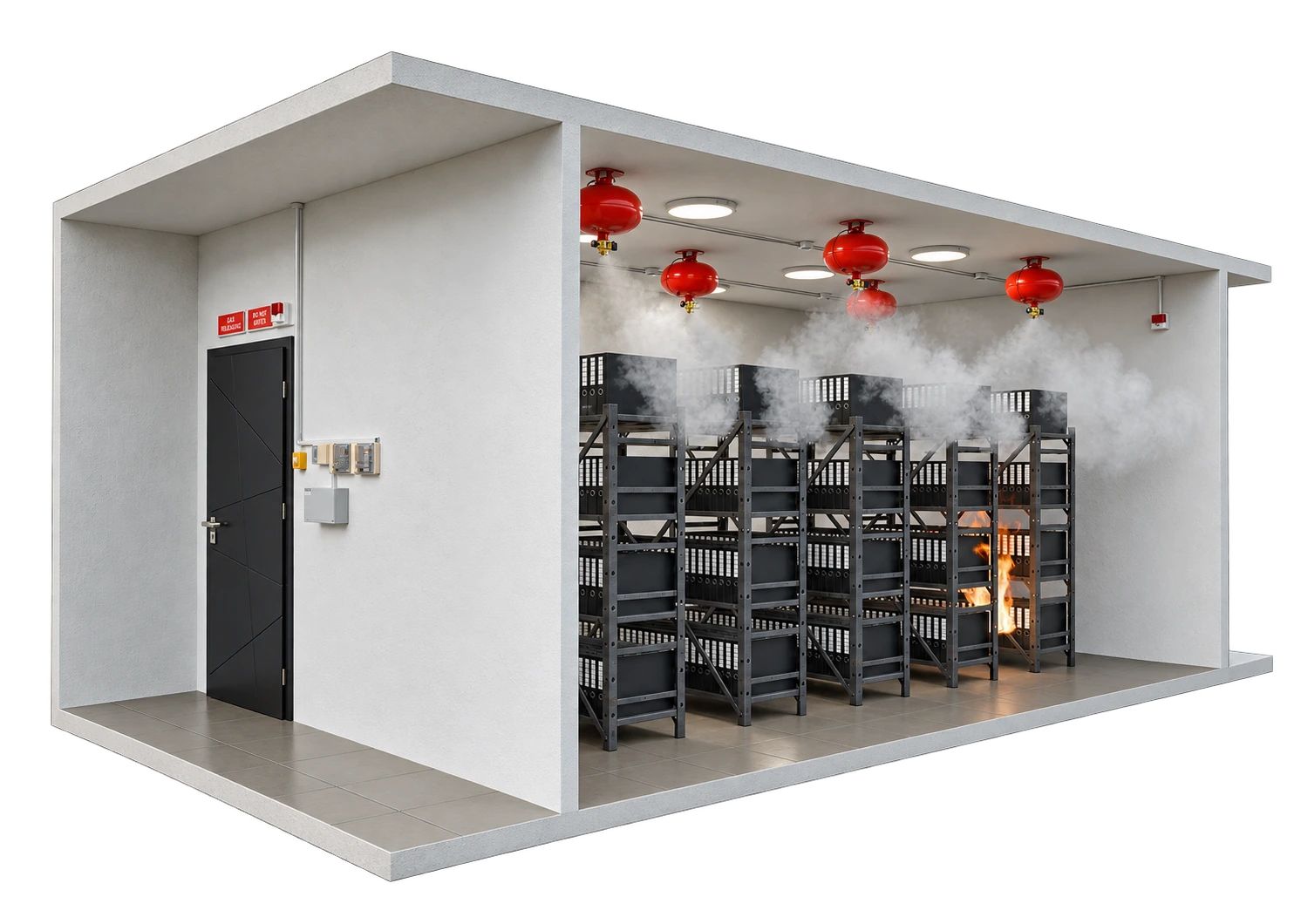
Archive fire safety considerations
Archives hold often irreplaceable documents: historical materials, legally significant records, photographs, films and electronic media. Storage rooms have closed doors and restricted access, densely packed shelving and tightly controlled conditions. Few people are usually inside, so a fire may be noticed late.
Potential ignition sources:
- faults in wiring, lighting or climate-control equipment;
- staff or visitors violating fire safety rules;
- high fire loads from paper, cardboard and film;
- spontaneous ignition of certain materials under improper storage conditions, particularly nitrate film.
Consequences of fire:
- irreversible loss of unique documents;
- loss of cultural and scientific heritage;
- financial damage;
- loss of legally significant records and resulting disputes;
- interruption of the archive owner's operations.
Major archive fires illustrate the scale. In January 2015, a fire in Moscow destroyed around 15% of the collections of the Russian Academy of Sciences' Institute of Scientific Information on Social Sciences. Documents that survived the flames were damaged by firefighting water.
Where gas is less effective
Gas effectively extinguishes open flames. Densely packed paper can smoulder deep inside a bundle or box, where gas penetration is poor: the surface flame goes out while internal smouldering continues. Archives therefore need both early detection at the smoke stage and storage arrangements that let gas pass between shelves and into cabinets.
Kazakhstan requirements for archive fire protection
Many Kazakhstan texts about archive fire suppression are copied from Russian websites together with Russian regulations: СП 5.13130.2009, ГОСТ Р 53281-2009, Federal Law No. 123 and, for archives, Russian Ministry of Culture Order No. 3 of 12 January 2009. For a Kazakhstan facility, the expert and emergency department inspector check the design against Kazakhstan documents.
| Document | What to check |
|---|---|
| Rules for acquisition, storage, accounting and use of National Archival Fund documents by state and specialised state archives (Kazakhstan Minister of Culture and Sport Order No. 215 of 9 August 2023) | Clause 108: separate storage with non-combustible walls and floors rated for at least two hours; do not route water or sewer pipes through it. Clause 114: fire safety arrangements under Kazakhstan law. Clause 120: storage temperature and humidity. The archive building must have a fire alarm system. |
| Rules for receipt, storage, accounting and use of National Archival Fund documents by departmental and private archives | Requirements for organisational archives that keep records before transfer to a state archive. |
| Technical regulation “General Fire Safety Requirements” (Kazakhstan Ministry of Emergency Situations Order No. 405 of 17 August 2021) | Clauses 44–50 and Appendix 16: room categories. Clause 135: extract gas after suppression as designed. Clause 150: gaseous suppression and smoke-control ventilation must not operate simultaneously in the fire room. Clause 212: cylinders undergo inspection before installation. |
| СН РК 2.02-02-2023 “Fire Automation of Buildings and Structures” | Section 5: buildings and rooms requiring automation. Section 9: gaseous fire suppression. 9.1 system construction; 9.2 nozzles; 9.3 protected room requirements; 9.4 local volumetric suppression; 9.5 control. |
| СП РК 2.02-102-2022 “Fire Automation of Buildings and Structures” | Section 5.4 with Appendices Г–Е: agent mass formulas, correction factors and pressure relief opening calculation. Fluoroketone is not on the code's list of agents. |
| Fire Safety Rules (Kazakhstan Ministry of Emergency Situations Order No. 55 of 21 February 2022) | Clause 70: fire automation system acceptance report. Clause 76: cylinders with overdue inspections are not accepted for installation. |
| TR EAEU 043/2017 | Mandatory certification of modules and extinguishing gases. |
| СТ РК 1902-2009, СТ РК 1900-2009, СТ РК 2512-2014 | Modules and cylinder banks, distribution devices and extinguishing gases for gaseous suppression systems. СТ РК 1902-2009 is Kazakhstan's counterpart to ГОСТ Р 53281-2009. |
СТ РК standards are included in the standards list for ТР ЕАЭС 043/2017. The former СН РК 2.02-11-2002 was withdrawn on 1 March 2023 but still appears in technical briefs. If you receive such a brief, request an updated reference before expert review.
Storage conditions the system must preserve
National Archival Fund storage rules define temperature and humidity for each media type (clause 120). Sudden variations are prohibited: no more than ±5 °C in temperature or ±10% in humidity (clause 125). Water suppression disrupts these conditions for an extended period; after gaseous suppression, ventilation restores normal storage conditions.
| Media | Temperature | Relative humidity |
|---|---|---|
| Paper | +17…+19 °C | 50–55 % |
| Black-and-white nitrate film | +10 °C | 40–55 % |
| Black-and-white safety film and photographs | +15 °C | 40–55 % |
| Colour films and photographs | +2…+5 °C | 40–55 % |
| Magnetic tape and disk media | +8…+18 °C | 45–65 % |
| Electronic media | +15…+20 °C | 50–65 % |
Nitrate document storage is isolated from other rooms and provided with additional low-level extraction (clause 113). For gaseous suppression, it is a separate zone with its own calculation.
At what area does archive protection become mandatory?
Rooms requiring suppression systems are listed in Section 5 of СН РК 2.02-02-2023 (version amended through 11 August 2026). Russian thresholds in СП 5.13130 and СП 486 do not apply in Kazakhstan.
Archive storage fire hazard category
These rooms usually fall into fire hazard categories В1–В4. The designer calculates the precise category using the specific fire load of a room area under Appendix 16 to Technical Regulation No. 405 and records it in the design documentation (clause 45).
| Category | Specific fire load in the area, MJ/m² |
|---|---|
| В1 | over 2200 |
| В2 | 1401 to 2200 |
| В3 | 181 to 1400 |
| В4 | 1 to 180 |
System acceptance from 2026
From 1 February 2026, regional and nationally significant city emergency departments accept fire automation systems. Acceptance is free and takes up to 15 working days. Submit an electronic application signed digitally, with the approved design, positive expert conclusion and equipment conformity documents. Acceptance is refused if installation does not match the design or documents are inaccurate.
Benefits of gaseous suppression for archives
- No secondary damage. Gas does not wet paper, photographs or film. Water soaks sheets and smears ink; drying can leave documents warped and mouldy.
- Rapid suppression. Gas suppresses fire at an early stage, while only one shelving unit is burning.
- Gas fills the entire volume. It reaches between shelves and into cabinets and boxes.
- Clean after discharge. No powder or foam cleanup is required.
- Storage conditions are preserved. Gas adds no moisture, and ventilation restores storage conditions.
| Method | Residue on documents | Archive applications |
|---|---|---|
| Water, sprinklers | moisture, soaked paper, mould after drying | corridors and auxiliary rooms; not in storage rooms |
| Water mist | less water, but moisture remains and disrupts storage conditions | subject to a specific design decision |
| Powder | residue that contaminates paper and corrodes staples and cabinets | not recommended for storage rooms |
| Aerosol | deposits on documents | not recommended for storage rooms |
| Gas | none | archive storage, special collections, server rooms and electrical switchrooms |
Suitable gases for archives
HFC-227ea and HFC-125
- quickly extinguish burning paper and cardboard;
- require low concentrations and relatively little gas;
- compact modules fit more easily into confined archives;
- the HFC-227ea standard concentration of 7.2% is below the human safety threshold of 9.0%.
HFC-125 is cheaper, but its working concentration of 9.8% exceeds the human safety threshold of 7.5%. It is not used in storage rooms where staff work.
Fluoroketone FK-5-1-12
- does not deplete the ozone layer;
- extinguishes at a 5.4% concentration, while its safety threshold for people is 10%;
- does not cause corrosion or leave traces on documents;
- is electrically non-conductive and suitable for electronic media storage.
Gas comparison: a 100 m³ archive storage room in Almaty
| Gas | Design concentration | Human exposure safety threshold (NOAEL, NFPA 2001) | Gas weight | Module |
|---|---|---|---|---|
| HFC-227ea | 7,2 % | 9,0 % | 63.8 kg | 1 × 60 l |
| Fluoroketone FK-5-1-12 | 5,4 % | 10 % | 87.7 kg | 1 × 80 L |
| HFC-125 | 9,8 % | 7.5%, below the working concentration | 63.9 kg | 1 × 80 L |
The figures are preliminary. At Almaty's altitude of about 850 m the agent mass is lower than at sea level: the correction under Table Д.11 of SP RK 2.02-102-2022 is 0.90. For a specific storage room the mass is calculated in the design, taking its openings and tightness into account.
FK-5-1-12 is not described in SP RK 2.02-102-2022. In this case clause 9.1.6 of SN RK 2.02-02-2023 refers to the manufacturer's documentation. For the table we used 5.4% under Russian SP 485 as amended by Amendment No. 2. If the designer used a different value, ask for the source.
Selection: use FK-5-1-12 fluoroketone in storage rooms where staff work. For infrequent access, the cheaper HFC-227ea is suitable. Carbon dioxide is not used in staffed archives because its extinguishing concentration is life-threatening.
Gaseous fire suppression system design
The archive design includes:
- gas weight based on room volume, shelving density and leakage;
- nozzle placement for even gas distribution between shelves;
- early detection using aspirating or point smoke detectors that detect smoke before open flames;
- warnings suited to staff work locations and a release delay allowing evacuation;
- ventilation and air-conditioning shutdown before release (clause 150 of Regulation No. 405);
- zoning with separate protection for each storage room, reading room, special collection and server room;
- a pressure relief vent and the post-discharge gas extraction procedure.
Modules in each room or one central station
A small archive can use ceiling-mounted modules in each storage room, installed without piping or welding and without stopping archive operations. A large archive with several rooms is better served by one floor-mounted cylinder bank in a separate room, supplying the required storage room through selector valves.
We manufacture FireStop modules in Almaty and design the system around actual equipment. If you already have a design, even using another manufacturer's equipment, we will check the gas calculation, nozzles, piping and pressure relief vent free of charge.
Design stages
1. Pre-design archive survey
- review rooms and media types in each storage area;
- assess fire load by shelving density and type;
- check tightness, ventilation and climate-control equipment;
- identify potential fire spread paths.
2. Design
- prepare the technical brief considering storage conditions;
- calculate agent weight, hydraulics and pressure relief vents;
- agree the agent and equipment layout with archive management.
3. Expert review and approvals
- submit the design for expert review and address comments until a positive conclusion is obtained;
- agree a schedule that keeps reading rooms and document services open.
4. Installation, commissioning and handover
- install by zone during agreed work windows;
- accept only cylinders with a valid inspection for installation (clause 76 of the Fire Safety Rules and clause 212 of Regulation No. 405);
- test the system without discharging gas;
- train staff and hand over the system to the emergency department.
5. Maintenance
- perform scheduled checks without interrupting archive operations;
- monitor module pressure and agent weight;
- maintain the service log.
Checklist: is the archive ready for gaseous fire suppression
Go through the list before design: each item affects the calculation and acceptance of the system.
- Storage rooms are separated from other premises, and unnecessary openings and holes for cables and pipes are sealed.
- Doors have closers and seals, and doors are not kept open.
- Ventilation and air conditioning shut down on a fire signal, and ducts have dampers.
- The design includes a calculated pressure relief opening and a relief valve.
- Early warning detectors are placed so that shelving does not block them.
- There is a warning sign and a manual release button at the storage entrance, and staff know the evacuation procedure.
- The storage temperature and humidity regime is taken into account in the design.
- There is a design, an acceptance certificate and a maintenance contract with an organisation holding a permit from the Ministry of Emergency Situations.
How much does archive gaseous fire suppression cost?
Pricing is calculated for the facility and depends on:
- the number and volume of storage rooms;
- the gas: fluoroketone, HFC-227ea or HFC-125;
- ceiling-mounted modules or a piped central station;
- early detection and warning systems;
- pressure relief vents;
- design, expert review and maintenance.
Frequently asked questions
Will gas damage documents, photographs or film?
No. Gas leaves no moisture or residue, so after ventilation the storage room needs no drying or cleanup.
Can installation proceed without closing the archive?
Yes. Work is carried out by zone during agreed windows. Ceiling-mounted modules require no piping or welding.
Which gas suits electronic media storage?
FK-5-1-12 fluoroketone or HFC-227ea: both are electrically non-conductive and leave no traces on media. HFC-125 is suitable only where no people enter the storage room.
Do you service systems already installed in archives?
We maintain and refill systems using FireStop modules. We do not fill other manufacturers' modules.