
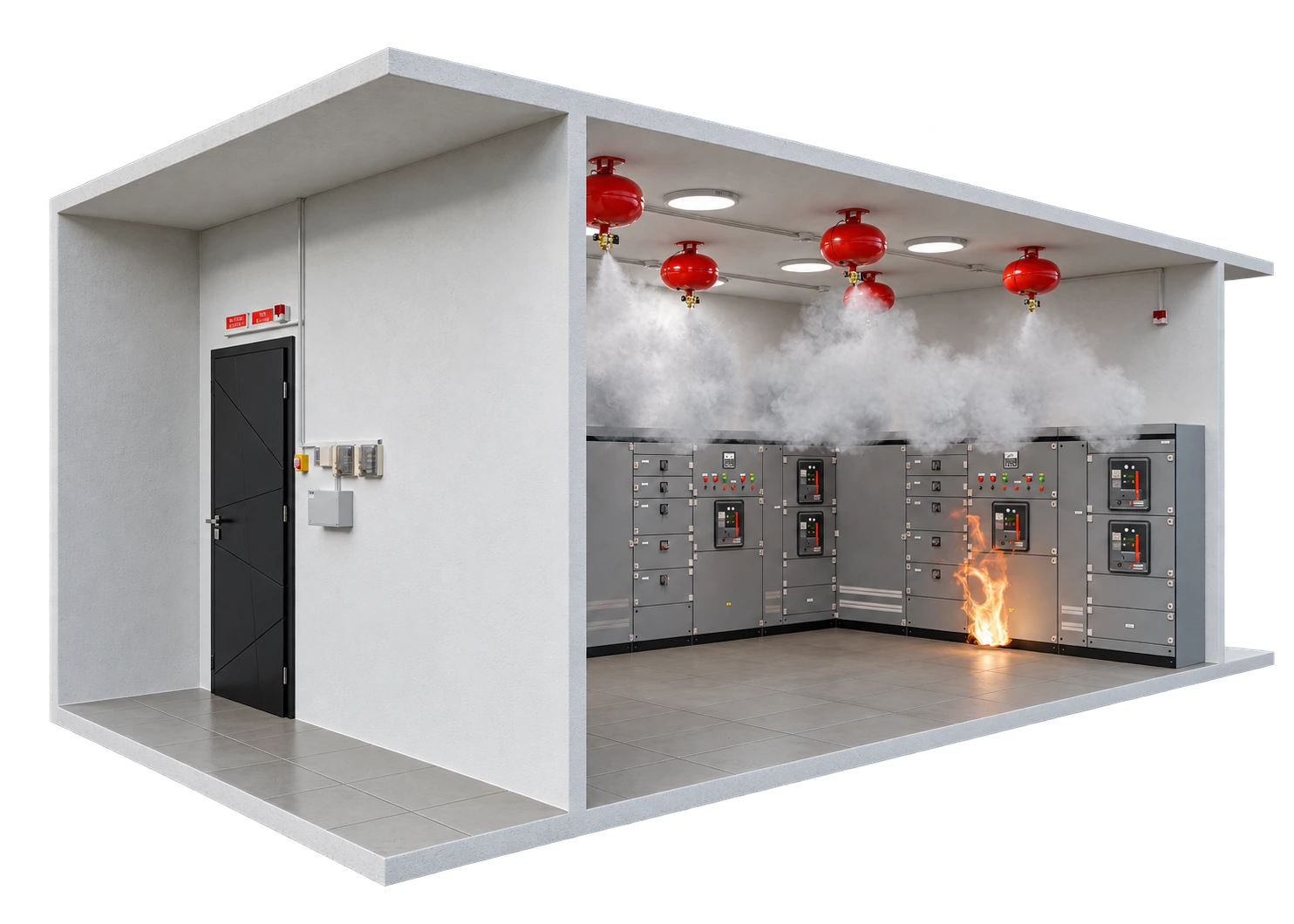
Fire safety considerations for switchgear rooms
A switchgear room is among a building's highest fire-risk spaces. It contains incoming distribution equipment, main switchboards, circuit breakers, transformers and cable entries under continuous load. A fire can leave the building without power and spread along cables to adjacent rooms.
Potential ignition sources:
- short circuits in devices and busbars;
- wiring overheating due to overload or an incorrectly selected conductor cross-section;
- sparking and heating at connections, including copper-to-aluminium joints;
- cable insulation ageing and damage;
- switchgear faults;
- dust and moisture causing abnormal operating conditions;
- installation errors and poor-quality components.
Consequences of fire:
- loss of power to the entire building;
- interruption of industrial and business processes;
- failure of expensive equipment;
- fire spreading to adjacent rooms;
- danger to people in the building;
- downtime and restoration costs.
Room or cabinet: two different tasks
A switchboard fire develops inside its enclosure: overheating, smouldering insulation, a short circuit and finally open flames. An individual cabinet with expensive controls is protected locally by discharging gas directly into its volume. A dedicated room containing several cabinets is protected as a whole, considering volume, airtightness and evacuation. These tasks must not be confused: applying the same solution to a single board and an entire room may fail to suppress the fire or cost too much.
Regulatory requirements for switchgear room fire protection in Kazakhstan
Many Kazakhstan texts on switchgear room suppression are copied from Russian websites along with Russian requirements: SP 5.13130.2009, GOST R 53281-2009, Federal Law No. 123, Russian electrical installation rules and SP 256.1325800.2016. For a Kazakhstan facility, experts and emergency department inspectors assess designs against Kazakhstan documents.
| Document | What to check |
|---|---|
| Technical regulation “General Fire Safety Requirements” (Kazakhstan Ministry of Emergency Situations Order No. 405 of 17 August 2021) | Clauses 44–50 and Appendix 16: room categories. Clause 133: electrical equipment matches the category and group of combustible mixture in its zone. Clause 135: gas is removed after suppression as designed. Clause 150: gaseous suppression and smoke ventilation do not operate simultaneously in the fire room. Clause 212: cylinders are inspected before installation. |
| СН РК 2.02-02-2023 “Fire Automation of Buildings and Structures” | Section 5: buildings and rooms requiring automation. Section 9: gaseous fire suppression. 9.1 system construction; 9.2 nozzles; 9.3 protected room requirements; 9.4 local volumetric suppression; 9.5 control. |
| СП РК 2.02-102-2022 “Fire Automation of Buildings and Structures” | Section 5.4 and Appendices Г, Д and Е: method for calculating the agent mass and the pressure relief opening area. FK-5-1-12 is not described in the code. |
| Fire Safety Rules (Kazakhstan Ministry of Emergency Situations Order No. 55 of 21 February 2022) | Clause 70: fire automation system acceptance report. Clause 76: cylinders with overdue inspections are not accepted for installation. |
| TR EAEU 043/2017 | Mandatory certification of modules and extinguishing gases. |
| СТ РК 1902-2009, СТ РК 1900-2009, СТ РК 2512-2014 | Modules and cylinder banks, distribution devices and extinguishing gases for gaseous suppression systems. СТ РК 1902-2009 is Kazakhstan's counterpart to ГОСТ Р 53281-2009. |
| Kazakhstan electrical installation rules (Energy Minister Order No. 230 of 20 March 2015) | Clauses 2088–2090: switchgear room requirements. Clause 2180: suppression systems are powered by independent lines from a substation, main switchboard or incoming distribution unit. Clause 541: mutually redundant suppression cable lines are routed so a fire cannot disable them simultaneously. |
СТ РК standards are included in the standards list for ТР ЕАЭС 043/2017. The former СН РК 2.02-11-2002 was withdrawn on 1 March 2023 but still appears in technical briefs. If you receive such a brief, request an updated reference before expert review.
Section 9 of SN RK 2.02-02-2023 includes a separate Clause 9.4 for local volume gaseous suppression. It governs individual cabinets or cabinet groups when whole-room protection is unnecessary.
What Kazakhstan electrical installation rules require of the room
- incoming units, incoming distribution units and main switchboards are installed in rooms accessible only to maintenance staff; in flood-prone areas, above flood level (Clause 2088);
- the room is not located below toilets, showers, kitchens, wash areas or other wet-process rooms unless reliable waterproofing is provided (Clause 2089);
- rooms with incoming distribution units and main switchboards have natural ventilation, electric lighting and a temperature of at least +5 °C (Clause 2090).
For gas suppression, this means two things. The designer accounts for natural ventilation as leakage and closes it with dampers during discharge. If the room is in an unheated building area, the minimum +5 °C temperature is checked against module and agent datasheets.
At what room area does protection become mandatory?
The list of rooms requiring suppression systems appears in Section 5 of SN RK 2.02-02-2023 (amended as of 11 August 2026). Russian SP 486.1311500 requirements do not apply in Kazakhstan.
Switchgear room fire hazard category
These rooms usually fall into fire hazard categories В1–В4. The designer calculates the precise category using the specific fire load of a room area under Appendix 16 to Technical Regulation No. 405 and records it in the design documentation (clause 45).
| Category | Specific fire load in the area, MJ/m² |
|---|---|
| В1 | over 2200 |
| В2 | 1401 to 2200 |
| В3 | 181 to 1400 |
| В4 | 1 to 180 |
System acceptance from 2026
From 1 February 2026, regional and nationally significant city emergency departments accept fire automation systems. Acceptance is free and takes up to 15 working days. Submit an electronic application signed digitally, with the approved design, positive expert conclusion and equipment conformity documents. Acceptance is refused if installation does not match the design or documents are inaccurate.
Benefits of gaseous suppression for switchgear rooms
- Gas is non-conductive. It extinguishes energised equipment without disconnecting building power. FireStop modules support suppression of equipment energised at up to 1,000 V.
- Equipment is not damaged. Powder covers contacts with dust; water and foam cause further short circuits. Gas leaves no residue and does not cause corrosion.
- Gas fills the entire volume. It reaches inside switchboards and cable ducts.
- Suppression is fast. The system suppresses an early-stage fire before it spreads along cables.
- Downtime is short. The room is ventilated and returned to operation.
- Adjacent rooms are unaffected. Gas does not leak to lower floors like water.
| Method | Energised equipment | Residue on equipment |
|---|---|---|
| Water, foam | only after de-energising | moisture, further short circuits |
| Water mist | subject to manufacturer restrictions | moisture on devices |
| Powder | up to the manufacturer's specified voltage | dust on contacts, lengthy cleaning before restart |
| Aerosol | up to the manufacturer's specified voltage | residue and hot generator products on accidental activation |
| Gas | yes, FireStop modules up to 1,000 V | none |
Which agents suit a switchgear room?
HFC-227ea and HFC-125
- effectively suppress fires in energised electrical installations (Class E fires);
- low operating concentration allows smaller modules;
- do not corrode contacts;
- suppress early-stage fires.
HFC-125 costs less, but its 9.8% operating concentration exceeds the 7.5% human safety threshold. It is often used in rooms entered only for maintenance.
Fluoroketone FK-5-1-12
- does not deplete the ozone layer;
- non-conductive, suppresses fires in energised equipment;
- leaves no residue on protection relay electronics or controllers;
- the widest safety margin for people: a 10% threshold at an extinguishing concentration of 5.4%.
Inert gases
- do not chemically affect equipment;
- do not decompose in flames;
- require high-pressure cylinders and substantial station space, so are uncommon in switchgear rooms.
Agent comparison: a 100 m³ switchgear room in Almaty
| Gas | Design concentration | Human exposure safety threshold (NOAEL, NFPA 2001) | Gas weight | Module |
|---|---|---|---|---|
| HFC-227ea | 7,2 % | 9,0 % | 63.8 kg | 1 × 60 l |
| Fluoroketone FK-5-1-12 | 5,4 % | 10 % | 87.7 kg | 1 × 80 L |
| HFC-125 | 9,8 % | 7.5%, below the working concentration | 63.9 kg | 1 × 80 L |
This is a preliminary estimate. For Almaty, at about 850 m, a 0.90 correction from Table Д.11 of SP RK 2.02-102-2022 is applied, and the design recalculates the mass for the openings and tightness of the electrical room.
The Kazakhstan code gives no design concentration for FK-5-1-12, so under clause 9.1.6 of SN RK 2.02-02-2023 it is specified from the manufacturer's documentation. We calculated with 5.4% from Russian SP 485 as amended by Amendment No. 2. Check any other figure in your design with the designer.
How to choose: lower-cost HFC-125 suits unoccupied rooms. Where staff enter frequently, choose fluoroketone or HFC-227ea. Room volume, equipment voltage and module space also affect selection.
Gaseous fire suppression system design
For a switchgear room, the designer specifies:
- agent mass accounting for room volume and switchboard configuration;
- nozzle or module placement so gas reaches inside switchboards and cable ducts;
- early detection: smoke detectors and separate in-enclosure sensors for cabinets with expensive controls;
- automatic, remote and manual actuation; manual controls located beyond the fire's reach;
- staff warnings before discharge;
- ability to disable automatic operation during electrical work to prevent discharge while an electrician is inside;
- system power via an independent line from the main switchboard or incoming distribution unit (Clause 2180 of Kazakhstan electrical installation rules);
- closure of natural ventilation dampers before discharge (Clause 150 of Regulation No. 405);
- a pressure relief vent and the post-discharge gas extraction procedure.
Suspended or floor-mounted modules
Switchgear rooms are usually small, making suspended modules convenient: no pipework, welding or prolonged shutdown. For large rooms or several adjacent rooms, one floor-mounted module bank protecting them through selector valves is more economical.
An individual cabinet uses local volume suppression (Clause 9.4 of SN RK 2.02-02-2023), discharging gas directly into the enclosure. The designer considers internal partitions, cable entries and maintenance access. Common errors include undersized modules, overlooked partitions and no power disconnection.
We manufacture FireStop modules in Almaty and design the system around actual equipment. If you already have a design, even using another manufacturer's equipment, we will check the gas calculation, nozzles, piping and pressure relief vent free of charge.
Design stages
1. Pre-design switchgear room survey
- review electrical equipment and layout;
- study the facility's power supply scheme;
- assess fire load and room category;
- determine the impact of a power interruption.
2. Design
- prepare a technical brief for the specific room;
- calculate agent mass and select modules;
- describe interfaces with power and ventilation;
- agree the design with the facility's chief power engineer.
3. Expert review and approvals
- submit the design for expert review and address comments until a positive conclusion is obtained;
- agree the work schedule with the facility's electrical team.
4. Installation, commissioning and handover
- install with minimal disruption and in accordance with electrical safety rules;
- accept only cylinders with a valid inspection for installation (clause 76 of the Fire Safety Rules and clause 212 of Regulation No. 405);
- test the system without discharging gas;
- train staff in discharge response and hand over the system to the emergency department.
5. Maintenance
- inspect the system as specified at times agreed with the electrical team;
- respond to fault signals;
- monitor module pressure and agent mass.
How much does switchgear room gaseous suppression cost?
Pricing is calculated for the facility and depends on:
- room volume or number of protected cabinets;
- agent: HFC-125, HFC-227ea or fluoroketone;
- suspended modules or a bank with selector valves serving multiple rooms;
- equipment voltage;
- controls, warnings and pressure relief vent;
- design, expert review and maintenance.
Frequently asked questions
Must the room be de-energised before suppression?
No, if voltage does not exceed 1,000 V: gas is non-conductive. Ventilation closes automatically before discharge.
Can one system protect several switchgear rooms?
Yes, if they are adjacent. One floor-mounted module bank supplies gas to the required room through selector valves.
What if electricians are working inside?
During work, automatic operation is switched to manual mode to prevent accidental discharge. Afterwards, automatic operation is restored and recorded in the log.
How many modules does the room need?
It depends on room volume and airtightness. Send the dimensions and we will calculate it.